Password vault breaches have become rarer as encryption improves, but a new attack surface has opened in their place. In 2026, threat actors are shifting away from brute force and towards the key escrow mechanisms that password managers use for account recovery, multi-device sync, and emergency access. Key escrow attacks bypass encryption entirely by compromising the infrastructure designed to hold, verify, and release encryption keys.
A key escrow attack targets the systems that manage cryptographic keys on behalf of vault users, rather than the encrypted vault itself. Unlike traditional breaches, these attacks don't require cracking encryption or defeating authentication. Instead, attackers compromise recovery workflows, exploit weak verification processes, or infiltrate the third-party services that custody escrow keys. For organisations storing sensitive passwords in vaults with inadequate escrow protection, the result is the same as a direct breach: complete credential compromise.
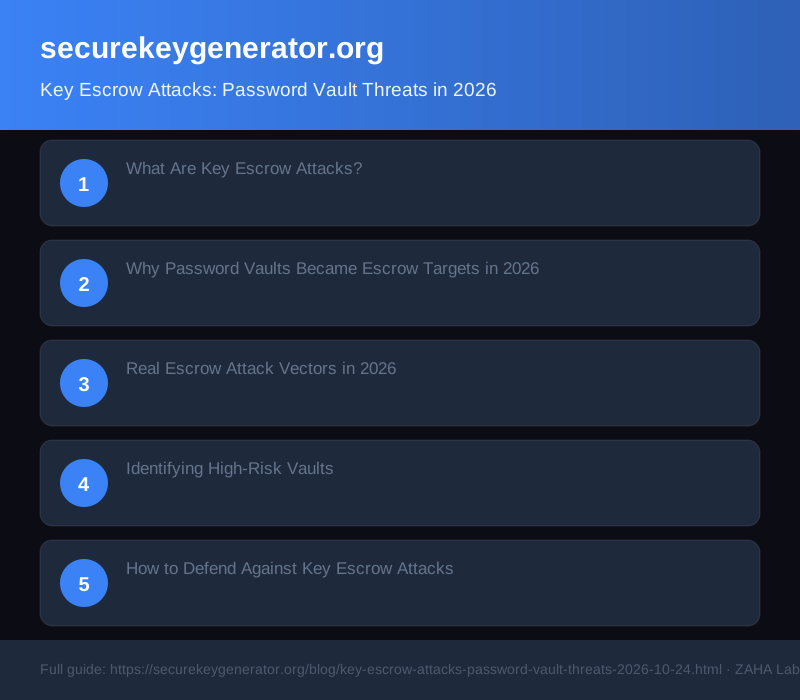
What Are Key Escrow Attacks?
Key escrow refers to the practice of placing cryptographic keys under the custody of a third party or service. In password vaults, escrow serves legitimate functions: it allows users to recover access if they forget their master password, it enables encrypted data to sync across multiple devices, and it can provide emergency access to designated contacts during death or incapacity.
A key escrow attack does not target encryption directly. Instead, it exploits weaknesses in how those keys are stored, transported, verified, and released. An attacker pursuing an escrow attack might:
- Compromise the third-party service holding recovery keys or key material
- Intercept key material during recovery flows or device synchronisation
- Exploit weak authentication on account recovery claims
- Use social engineering to trigger illegitimate key recovery without detection
- Abuse the verification mechanisms designed to prevent unauthorised key release
This approach is far simpler than attacking encryption. Encryption is mathematically hard. The human and procedural systems around key recovery are not. By targeting escrow instead of encryption, attackers convert a problem with a centuries-long solution time into one solvable in hours.
Why Password Vaults Became Escrow Targets in 2026
Encryption became ubiquitous and unbreakable. Reputable password managers now deploy end-to-end encryption by default. Stealing an encrypted vault database is worthless without the key, so attackers have stopped trying. Escrow is what remains.
Account recovery is now a regulatory requirement. Data protection authorities in the EU and UK expect password managers to offer legitimate mechanisms for users to recover access if they lose their master password. This regulatory pressure has forced vault providers to implement escrow processes, creating a new attack surface that didn't exist when vaults allowed no recovery at all.
Supply chain dependencies multiplied. Modern password vaults no longer operate in isolation. They depend on third-party key custodians, hardware security modules hosted in commercial data centres, recovery-code generation services, and cloud-based identity providers. Each dependency increases the number of organisations that hold vault keys and each is a potential weak link.
Real Escrow Attack Vectors in 2026
Recovery email compromise. Most password vaults use email as the primary recovery channel. An attacker who gains control of your recovery email address can request a key reset or open up without accessing the vault itself. If that email account uses password reuse or is tied to a compromised data breach, a vault recovery is a few clicks away.
Weak account recovery verification. Some vaults verify recovery requests using weak signals alone: a correct recovery email, knowledge of a personal security question, or a recovery code. Email can be spoofed or redirected. Security questions are guessable. Recovery codes stored in email or cloud backups are not secret. Social engineering or credential compromise defeats these checks entirely.
Compromised third-party escrow services. Vaults that outsource key escrow to third parties inherit their risk. A breach at an escrow provider, hardware security module vendor, or recovery service can compromise thousands of vault keys at once. These services often hold keys from multiple vault providers, making them high-value targets.
Insider threats at vault providers. Administrators at password vault companies have legitimate operational access to escrow systems. A disgruntled employee, contractor, or insider recruited by a threat actor can release keys under false recovery claims or administrative overrides. Detection is difficult because insider access looks legitimate in logs.
Key material leakage during sync. When a vault syncs across devices, keys or key-derived material sometimes flows through the provider's infrastructure, even under encryption. An attacker with network access to sync infrastructure, access to sync logs, or compromised intermediate systems might capture key material in transit.
Identifying High-Risk Vaults
Not all password managers handle escrow with equal care. Password vaults at highest risk from escrow attacks in 2026 share these characteristics:
- Email-only recovery. Vaults offering only email-based recovery have weak verification layers and rely entirely on email security, which is a known weakness.
- Centralised provider-held keys. Vaults where the provider holds master recovery keys or key material (rather than splitting keys or using client-side derivation) concentrate risk in the provider's infrastructure.
- No escrow transparency. Vaults that publish no documentation on how escrow works, where keys are held, who can access them, or how they are protected are impossible to audit for security.
- Single-factor recovery. If a single email address, recovery code, or knowledge factor opens up a vault, escrow attacks are simple because there is only one barrier to compromise.
- Third-party escrow without published audits. Vaults that outsource key holding but don't publish independent security audits of those services or custody arrangements create hidden risk.
How to Defend Against Key Escrow Attacks
Prioritise client-side recovery key design. The strongest defence against escrow attacks is a vault design that stores recovery keys on your device, encrypted with your master password, never held in escrow by the provider. This eliminates the escrow attack surface entirely because there is nothing for an attacker to compromise. The trade-off is permanent: if you lose your master password and your recovery keys, the vault cannot be accessed by anyone, ever. This is by design.
Require multi-factor recovery authentication. Look for password managers that gate key recovery behind multiple independent verification steps. This might mean email confirmation plus hardware security key verification, recovery codes plus biometric re-authentication, or recovery code plus SMS to a separate phone number. Each additional factor exponentially increases the cost and complexity of an escrow attack.
Add a hardware security key to your vault. Hardware security keys like YubiKey are available on Amazon UK and integrate with many password managers to add a second authentication factor that cannot be compromised through email recovery flows alone. An attacker must now also steal or compromise your physical hardware, which is significantly harder than compromising an email account.
Review your vault provider's published escrow policy. Read the documentation for your password manager on how recovery works. Does the provider hold keys? If so, who has access to those keys? Are the systems holding keys audited by third parties? Can you recover your vault without contacting the provider, or are you entirely dependent on their infrastructure? Understand your dependence on escrow.
Isolate your recovery email account. Never use your primary email address for vault recovery. Create a dedicated, rarely-used email account with a different provider. Secure that account with multi-factor authentication and a password so long and random that you cannot remember it. Store that password offline, in a safe location, where you can retrieve it only if you need vault recovery.
Verify independent security audits of your vault and escrow services. Request documentation that your password manager has undergone third-party security audits. Audit reports from reputable firms contain information on how keys are protected, who can access them, and what controls prevent unauthorised release. Audit reports are not bulletproof, but a vault provider unwilling to audit is a red flag.
FAQ
Can a password vault operate without key escrow at all?
Yes. Some password managers use a client-side recovery model where recovery keys are generated on your device and stored locally, encrypted with your master password. The vault provider has no copy of recovery keys and holds no escrow material. The cost of this design is finality: if you lose your master password and your recovery keys, your vault is permanently inaccessible. The provider cannot help you recover it. This is intentional. Strong security often requires accepting permanent loss as the penalty for losing a master password.
Are open-source password managers safer from escrow attacks?
Open source code is inspectable, which allows independent verification of escrow design. However, open source alone does not guarantee security. What matters is the escrow model itself. An open-source vault with centralised provider-held recovery keys is still vulnerable to escrow attacks. A closed-source vault with client-side recovery keys is safer. Inspect the design, not just the licensing model, to assess escrow risk.
What should I do if my password vault provider suffers an escrow-related breach?
If your vault provider confirms that escrow keys or recovery material have been compromised, assume your vault encryption keys are at risk. Change your master password immediately if you can still access the vault, then migrate all critical credentials to a new, uncompromised vault. For any account stored in the compromised vault that uses a weak or reused password, prioritise changing that password in the original service. Do not trust the compromised vault with new secrets until the provider has remediated the breach and published details on what was compromised.
Do commercial password managers like 1Password or Dashlane have weak escrow mechanisms?
Major commercial password managers publish security architecture documentation. Both 1Password and Dashlane employ end-to-end encryption and do not hold user master keys in escrow. However, both do offer account recovery mechanisms, which do require the provider to hold some recovery material or help recovery. The question is not the vendor but the mechanism: does the vault provider hold your encryption key itself, or only recovery material you can independently verify? Read the specific documentation from your chosen vault.
How does adding multi-factor authentication to vault recovery help against escrow attacks?
Multi-factor authentication on vault account recovery makes it significantly harder for an attacker to trigger illegitimate key release. If vault recovery requires both email verification and possession of a security key, approval via a second device, or biometric confirmation, then an attacker who has only your password or email cannot recover your keys. MFA does not eliminate escrow risk, but it raises the cost, complexity, and detection risk of an escrow attack from trivial to substantial.
Conclusion
Key escrow attacks represent a fundamental shift in how threat actors approach password vault compromise. Rather than attempting to crack encryption, attackers now target the systems designed to hold, manage, and release encryption keys. As password vault adoption grows and regulatory requirements force vault providers to implement recovery mechanisms, escrow attacks are becoming more attractive and more feasible. The defence is not to eliminate escrow entirely, which is often impractical, but to choose vault providers with strong escrow designs, understand exactly how your vault handles key custody and recovery, add multiple independent authentication layers to recovery processes, and accept that any system holding recovery keys carries some level of risk. The lowest-risk approach is to select a vault that minimises escrow dependencies, supports hardware security key authentication as a recovery factor, publishes transparent information on key custody, and undergoes regular independent security audits. Then, take the final step: keep your master password memorised or stored separately, offline, where you alone can retrieve it. Your vault is only as secure as the weakest link in its escrow chain.